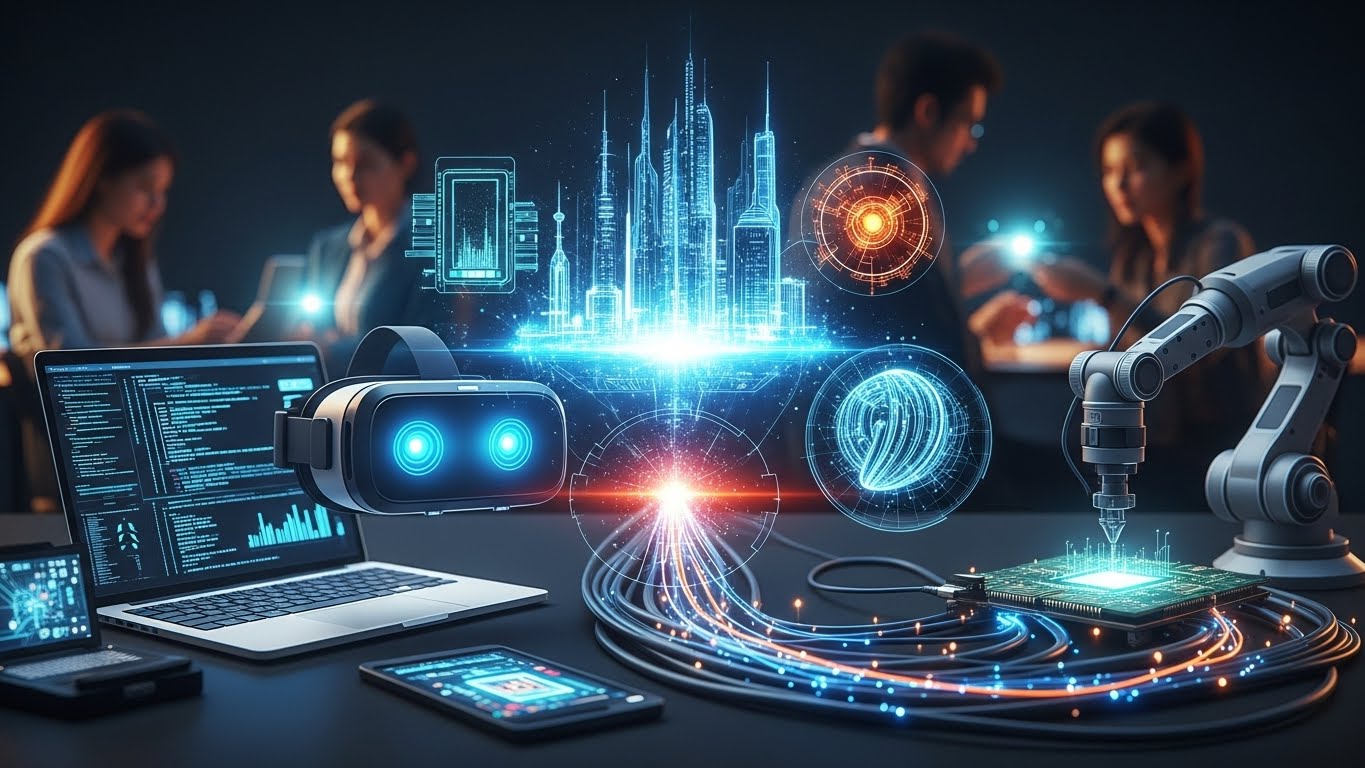

Technology often feels loud. We hear about bold product launches, buzzing innovations and disruptive breakthroughs. But some of the most significant shifts in our digital world are happening quietly, beneath the surface of our daily routines. While everyone talks about futuristic gadgets, the true transformation lies in how invisible technologies are reshaping how we live, work and think. In this blog post, we explore the subtle yet powerful trends redefining modern life and the ways they’re influencing our future without us even realizing it.
The Rise of Ambient Intelligence
Not long ago, smart devices were novel additions to our homes. Today, they form an interconnected mesh of awareness known as ambient intelligence. This concept refers to technology that fades into the background, functioning silently while observing and interpreting human behavior to offer assistance at the right moment.
Whether it is a thermostat adjusting itself based on your comfort patterns or a voice assistant preparing your morning routine before you even get out of bed, these systems are shifting the focus from manual control to contextual automation. The most profound part is their invisibility. The more these technologies improve, the less we notice them, even as they influence our daily choices and habits.
Ambient intelligence is steering us toward a future where devices don’t just respond to commands; they anticipate needs. This subtle shift could redefine everything from household management to healthcare monitoring, creating a world where assistance is not requested but offered intuitively.
Personalized Tools Powered by AI
Artificial intelligence has become a familiar term, but the way it adapts to personal behavior is what truly sets the current wave of innovation apart. Personalization is no longer about recommended movies or curated shopping lists. Instead, AI systems are learning to understand individual rhythms, emotional cues and long-term preferences.
Imagine an educational app that senses frustration and shifts its teaching style, or a fitness system that changes a workout plan based on how you slept the night before. These tools don’t just serve content; they respond to emotional and physical patterns, guiding us with a surprisingly human-like sensitivity.
While the algorithms behind this personalization can be complex, their impact appears natural and effortless, becoming part of our daily flow. This is where technology becomes more companion than tool, integrating itself into experiences in a way that feels intuitive rather than intrusive.
The Silent Revolution of Edge Computing
As digital services grow more sophisticated, the need for faster, more efficient processing has pushed innovation out of the cloud and closer to the user. Edge computing allows data to be processed locally on devices, reducing latency and improving speed.
This shift is more impactful than most people realize. You may not see edge computing, but you feel it in quicker app responses, more accurate real-time analysis and increasingly smooth interactions with smart devices. Autonomous vehicles, for example, depend heavily on edge computing because even millisecond delays can affect safety.
By processing information locally, devices can make instant decisions without relying heavily on remote servers. This hidden transformation supports the seamlessness that modern users have come to expect. It enables everything from wearable health monitors to powerful augmented reality tools, laying the groundwork for technologies that will feel even more natural and integrated in the future.
How Ultra-Fast Connectivity Is Reshaping Expectations
Connectivity has always been the backbone of technological advancement. While the excitement surrounding new network generations often focuses on speed, the deeper impact lies in what those speeds enable. With ultra-fast connections, developers can create richer, more immersive and more responsive digital experiences.
Consider a remote worker engaging in real-time collaboration without lag, or a gamer accessing cloud-based systems that feel as smooth as local hardware. High-speed networks also support large-scale data syncing, enabling smart cities to manage everything from traffic flow to public safety through interconnected sensors.
What makes this shift significant is not the speed itself but the change in expectations. Modern users no longer tolerate delay, and this has pushed industries to evolve in ways that prioritize instant access and continuous responsiveness. As a result, technology becomes woven more tightly into every moment of daily life.
The Rise of Invisible Interfaces
We used to tap keyboards. Then we tapped screens. Now, we are moving into an era where technology reacts to gestures, voice and even subtle facial expressions. These invisible interfaces mark a major shift in how we interact with digital tools.
The goal is simple: remove the friction between intention and action.
Gesture-based controls, voice recognition and eye-tracking systems all contribute to a world where input becomes more natural. Instead of thinking in terms of buttons and menus, users interact through their instincts. This trend is especially important for accessibility, giving people with disabilities more intuitive control over devices.
As invisible interfaces become more refined, they will redefine not just how we use technology, but how we think about interaction itself. Devices will feel less like machines and more like extensions of human intention.
Sustainability as a Technological Priority
A major and often overlooked transformation in tech is the shift toward sustainability-driven design. For years, innovation prioritized power and performance. Now, efficiency, recyclability and resource conservation are becoming central goals.
Manufacturers are revisiting production processes, exploring renewable materials and designing products that last longer and consume less energy. Software developers are optimizing algorithms to reduce processing demands, lowering the environmental impact of digital systems.
This shift is subtle because many improvements occur behind the scenes. You may never see the updated supply chain or energy-saving chip design, but these hidden innovations play a major role in reducing global emissions. The future of tech will be shaped not only by what devices can do but by how responsibly they do it.
Blurring the Line Between Digital and Physical Worlds
Augmented and mixed reality technologies are progressing quietly but steadily. While they may not yet dominate daily life, they are seeping into various industries, transforming how we learn, work and even socialize.
What makes this evolution noteworthy is the gradual blending of physical and digital layers. Instead of pulling us away from the real world, modern AR tools are enhancing our surroundings. Virtual instructions appear over physical equipment, digital communities interact through realistic avatars and creative tools allow artists to sculpt in three-dimensional digital spaces.
This convergence is setting the stage for environments where digital information becomes a natural part of physical space, making technology feel like an organic extension of reality rather than a separate realm.
Cybersecurity’s Quiet Reinvention
With every innovation comes new vulnerabilities. However, modern cybersecurity is evolving in ways that most users never notice. Behavioral biometric systems, AI-driven threat detection and zero-trust frameworks are being built into the backbone of devices and networks.
This invisible protection is essential for maintaining trust in a world full of digital interactions. Users may not be aware of the layers of security shielding their data, but these systems are constantly learning, adapting and improving behind the scenes.
The next era of cybersecurity won’t revolve around passwords and firewalls. It will rely on automatic threat prediction and silently adaptive defense systems that evolve faster than attackers can strategize.
The Future of Technology Is Subtle, Seamless and Human-Centered
The most transformative technologies aren’t always the most attention-grabbing. They operate quietly, refining everyday experiences and letting users focus on what matters most. Instead of commanding our attention, modern innovation is learning to integrate into our routines with minimal friction.
From ambient intelligence to invisible interfaces, today’s tech is moving in a direction where presence doesn’t equal disruption. The future is being built not only through bold inventions but through subtle refinements that make digital life feel more natural, intuitive and human.
As we move forward, the biggest shift won’t be in what technology can do, but in the way it becomes part of who we are and how we navigate the world around us. The transformation is already happening — quietly, smartly and everywhere.