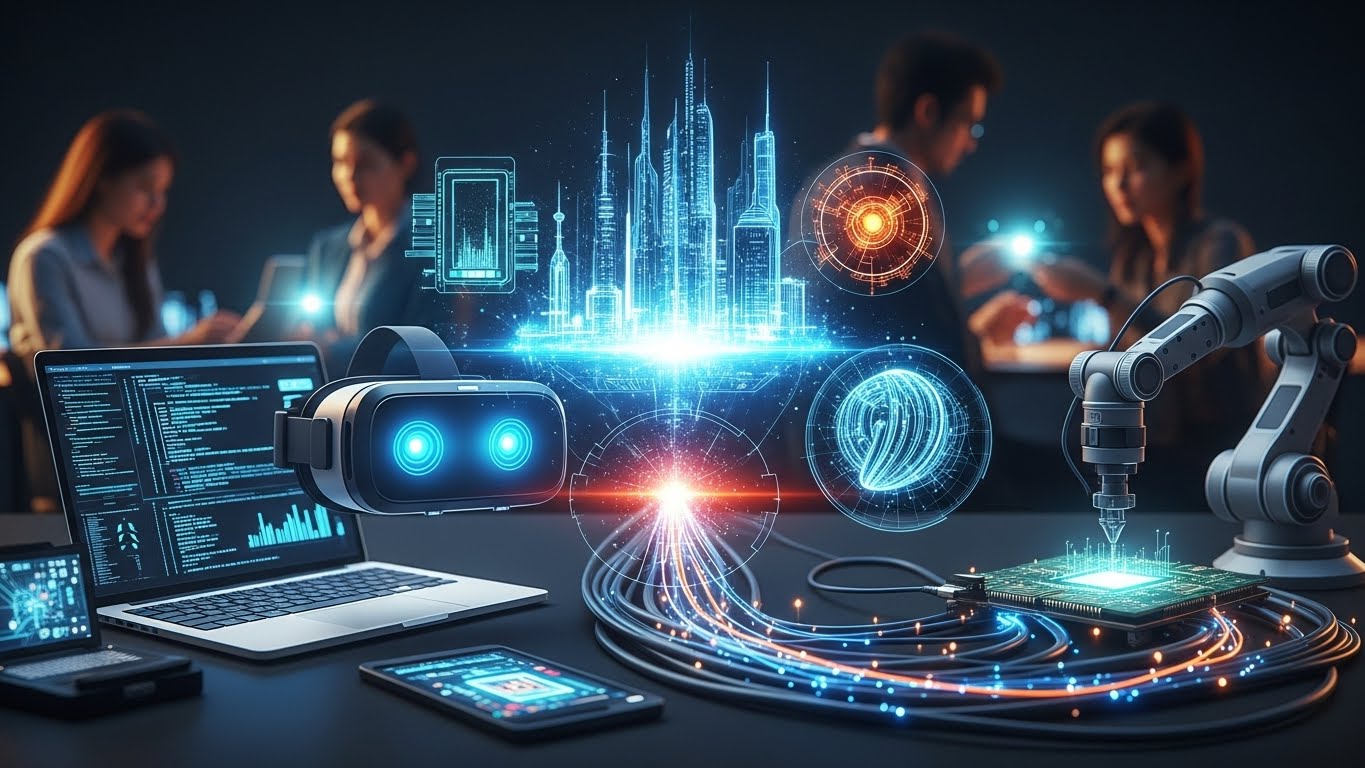
The world of technology is evolving at an unprecedented pace. From Artificial Intelligence (AI) to Quantum Computing, the boundaries of what is possible continue to stretch further. As we look to the future, new innovations are rapidly transforming how we live, work, and interact with the world around us. In this blog post, we’ll explore some of the most exciting technological advancements and how they will shape our future in ways we never thought possible.
The Rise of Artificial Intelligence: Transforming Industries
Artificial Intelligence has been one of the most talked-about technologies in recent years, and its impact is only just beginning to be felt across various industries. AI is no longer confined to the realm of science fiction; it is a powerful tool being used in healthcare, finance, retail, and even entertainment.
AI’s ability to analyze vast amounts of data and make predictions with remarkable accuracy is revolutionizing how businesses operate. In healthcare, for example, AI is used to assist doctors in diagnosing diseases by analyzing medical images with better accuracy than human doctors. In finance, AI algorithms are being used to detect fraud and automate trading. In retail, personalized recommendations powered by AI are changing how consumers shop online.
One of the most exciting aspects of AI is its potential for continuous learning and improvement. Machine learning, a subset of AI, enables systems to learn from experience, allowing them to adapt to new challenges and become more efficient over time. As AI continues to evolve, we can expect it to become even more integrated into our daily lives, transforming industries and improving the quality of services we receive.
The Power of 5G: A New Era of Connectivity
Another technological breakthrough that is rapidly changing the world is the rollout of 5G networks. The fifth-generation wireless technology promises to deliver lightning-fast internet speeds, ultra-low latency, and the ability to connect billions of devices simultaneously. But what does this mean for the average person?
With 5G, internet speeds will increase dramatically, allowing for faster downloads, smoother video streaming, and improved communication. But the impact of 5G goes beyond just speed. The ultra-low latency of 5G networks will open the door to new possibilities in fields such as autonomous vehicles, remote surgery, and the Internet of Things (IoT).
Self-driving cars, for example, rely on constant communication with other vehicles and infrastructure to navigate safely. 5G’s low latency will allow these vehicles to make real-time decisions, improving safety and efficiency on the road. In healthcare, 5G will enable remote surgeries and consultations, where doctors can perform complex procedures from miles away, offering medical care to underserved regions.
5G will also unlock the potential of IoT devices, enabling smarter homes, cities, and industries. From smart thermostats to connected refrigerators, the number of devices we interact with daily will grow exponentially. As 5G technology matures, we can expect a more connected and efficient world.
Quantum Computing: The Next Frontier of Computing Power
While AI and 5G are making waves in the tech world today, the true frontier of technological innovation lies in quantum computing. Quantum computing is poised to revolutionize industries by providing a level of computational power that is orders of magnitude greater than today’s most powerful supercomputers.
At its core, quantum computing relies on the principles of quantum mechanics to perform calculations that classical computers cannot. While classical computers process data in binary form—using bits that can either be 0 or 1—quantum computers use quantum bits, or qubits. These qubits can exist in multiple states simultaneously, allowing quantum computers to perform complex calculations at speeds that were previously unimaginable.
This has enormous implications for fields such as cryptography, material science, and artificial intelligence. Quantum computers could break current encryption methods, forcing a complete rethinking of cybersecurity. They could also simulate molecular structures with unprecedented accuracy, accelerating the discovery of new drugs and materials. In AI, quantum computing could vastly improve machine learning algorithms, enabling faster training of models and solving problems that are currently beyond our reach.
Although quantum computers are still in the experimental stages, they hold immense promise. As companies like IBM, Google, and Microsoft continue to make strides in developing quantum hardware, we may be on the brink of a new era in computing.
The Expansion of Virtual and Augmented Reality
Virtual Reality (VR) and Augmented Reality (AR) have been around for a while, but recent advancements in hardware and software are propelling these technologies into mainstream use. While VR immerses users in fully digital environments, AR overlays digital elements onto the real world, enhancing our perception of our surroundings.
The applications of VR and AR are vast. In gaming, VR allows players to experience games in an entirely new way, providing an immersive, 360-degree experience. In education, VR can transport students to historical events, distant planets, or the depths of the ocean, creating interactive learning environments that would be impossible with traditional methods. Similarly, AR is transforming industries such as retail, where customers can try on clothes or see how furniture would look in their homes without leaving their living rooms.
In healthcare, VR is being used for pain management and therapeutic purposes, while AR is assisting surgeons in performing complex procedures with real-time data overlays. The possibilities are endless, and as the technology becomes more accessible and refined, VR and AR will likely become integral parts of our daily lives.
Blockchain: Revolutionizing Security and Transparency
Blockchain technology has gained significant attention in recent years, largely due to the rise of cryptocurrencies like Bitcoin. However, the potential applications of blockchain go far beyond digital currencies. At its core, blockchain is a decentralized, distributed ledger that allows data to be stored in a secure, transparent, and tamper-proof way.
Blockchain has the potential to disrupt a wide range of industries, including finance, supply chain management, and healthcare. In finance, blockchain can streamline transactions by eliminating intermediaries and reducing transaction costs. In supply chain management, blockchain provides transparency by tracking products from their origin to the consumer, ensuring authenticity and reducing fraud. In healthcare, blockchain can securely store patient records, allowing for better data sharing between doctors and hospitals while maintaining privacy.
One of the key advantages of blockchain is its ability to ensure data integrity. Since all transactions are recorded in a public ledger that is immutable, it is virtually impossible to alter or tamper with data without detection. This has profound implications for security and trust in a wide range of industries.
The Impact of Robotics and Automation
As technology continues to advance, the role of robotics and automation in the workforce is becoming increasingly important. Robots are already being used in manufacturing, healthcare, and even agriculture, and their capabilities are improving rapidly. From assembly lines to warehouses, robots are performing repetitive tasks more efficiently than humans ever could.
In the healthcare industry, robots are assisting surgeons with precision tasks, and in agriculture, robots are being used to plant, water, and harvest crops, reducing the need for manual labor. Automation is also improving supply chains by increasing speed and reducing human error.
However, the rise of robotics and automation raises important questions about the future of work. While these technologies can improve productivity and reduce costs, they also have the potential to displace jobs. This is a challenge that will need to be addressed as we move forward, ensuring that workers have access to retraining and upskilling opportunities in order to thrive in an increasingly automated world.
Conclusion: A World Transformed by Technology
The future of technology holds incredible promise, with advancements like AI, 5G, quantum computing, and robotics set to transform every aspect of our lives. While these innovations bring tremendous benefits, they also raise important ethical, economic, and societal questions.
As we continue to develop and implement these technologies, it is crucial that we consider their potential impact on privacy, security, and equality. By doing so, we can harness the power of technology to create a better future for all.
The next few decades will undoubtedly bring profound changes, as technology becomes even more integrated into our daily lives. We are standing at the cusp of a new era—one that promises to redefine what it means to live and work in a digital world. The journey is just beginning, and the future is more exciting than ever.