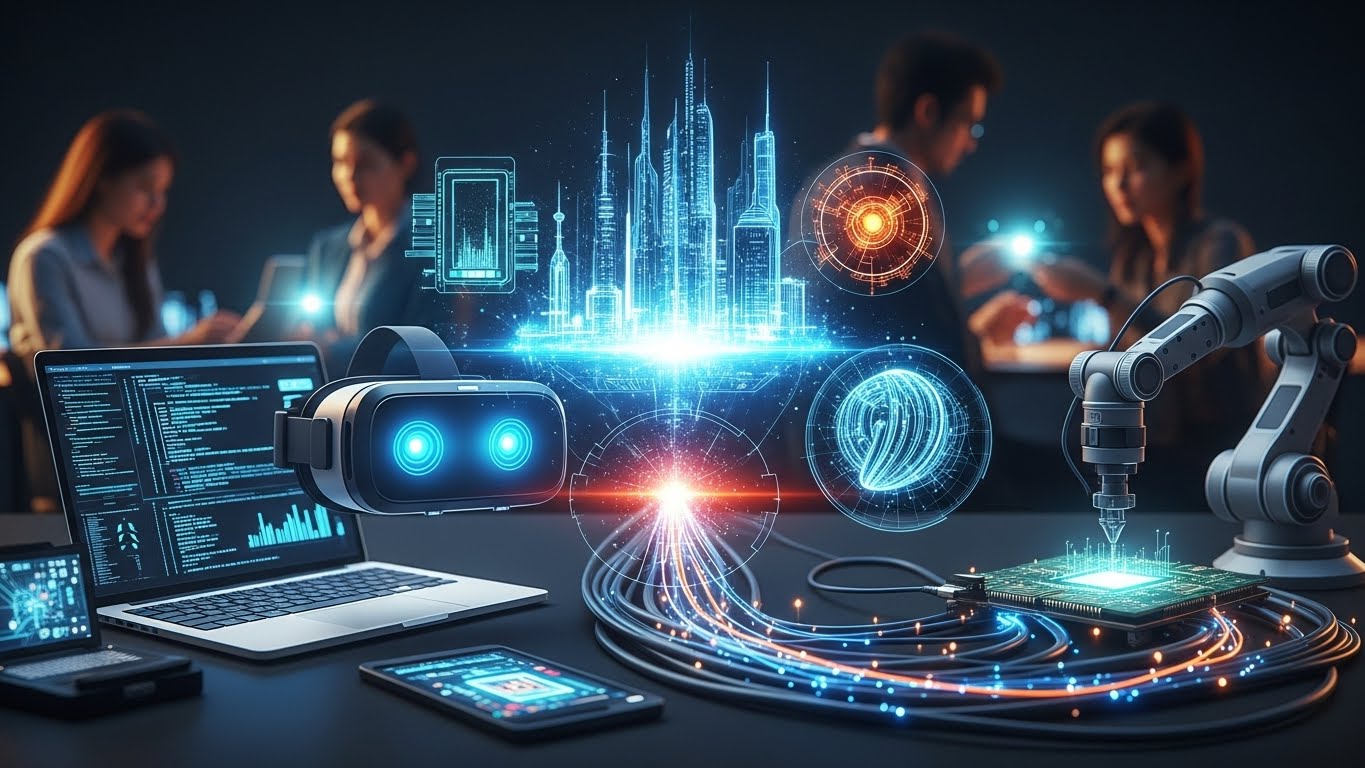

Technology has evolved at an unprecedented pace over the past few decades, transforming every aspect of human life. From the way we communicate and work, to how we access information and entertain ourselves, technology has fundamentally changed the world in ways that were once unimaginable. As we stand at the threshold of a new technological era, it’s essential to explore the innovations that are not only shaping our present but also setting the stage for the future. In this blog post, we’ll dive into the trends and breakthroughs that will define the future of technology and the impact they will have on society, businesses, and individuals.
The Age of Artificial Intelligence: From Automation to Human Augmentation
Artificial Intelligence (AI) is perhaps the most transformative technology of our time. Over the past decade, AI has made significant strides, moving from experimental algorithms to real-world applications that impact nearly every industry. From self-driving cars and virtual assistants to advanced data analytics and predictive models, AI is reshaping the way we interact with technology and each other.
One of the most exciting prospects of AI is its potential for automation. Automation powered by AI is already changing industries like manufacturing, logistics, and healthcare, reducing human error, improving efficiency, and creating new opportunities for innovation. For instance, AI-driven robots in factories can perform repetitive tasks with greater precision and speed, while algorithms in healthcare are helping doctors diagnose diseases with greater accuracy.
But AI’s impact extends far beyond automation. The true promise of AI lies in its ability to augment human capabilities. In fields like education, AI-driven tutoring systems can personalize learning experiences for students, while in the workplace, AI-powered tools can assist professionals in data analysis, decision-making, and creative tasks. The future of AI is not about replacing humans but rather enhancing our skills and allowing us to achieve more than we ever could on our own.
Quantum Computing: Unlocking New Frontiers in Processing Power
When it comes to computing, we’re only scratching the surface of what’s possible. Traditional computers, even the most advanced supercomputers, are limited by the constraints of classical physics. Quantum computing, however, represents a completely new paradigm that could unlock unimaginable computing power by harnessing the principles of quantum mechanics.
Quantum computers use qubits instead of traditional bits, allowing them to perform calculations in parallel and solve complex problems exponentially faster than classical computers. This could have profound implications for fields like cryptography, drug discovery, material science, and artificial intelligence. For example, quantum computers could crack encryption codes in seconds, leading to the need for more secure communication systems. In healthcare, quantum simulations could accelerate the development of new medicines by modeling molecular interactions at unprecedented speeds.
Although quantum computing is still in its infancy, the rapid advancements being made in this field suggest that we are not far from seeing its widespread application. Tech giants like IBM, Google, and Microsoft are investing heavily in quantum research, and several startups are racing to develop the first practical quantum computers. While we may be years away from fully realizing the potential of quantum computing, the future it promises is one of limitless possibilities.
The Rise of 5G: A Connected World
The rollout of 5G networks is another key development that will have a profound impact on technology in the coming years. 5G, the fifth generation of mobile network technology, promises to offer faster speeds, lower latency, and greater capacity compared to current 4G networks. This will enable new use cases that were previously impossible, particularly in areas like the Internet of Things (IoT), autonomous vehicles, and smart cities.
One of the most exciting aspects of 5G is its potential to power the next generation of IoT devices. With 5G’s increased bandwidth and low latency, millions of connected devices can communicate in real-time without lag, opening the door to smart homes, connected factories, and even smarter healthcare systems. For instance, 5G-enabled devices could monitor patients’ vital signs remotely and transmit data in real time, allowing doctors to provide immediate care in critical situations.
In the realm of transportation, 5G will be the backbone of autonomous vehicles. Self-driving cars rely on real-time data from sensors, cameras, and GPS to navigate safely, and the low latency of 5G networks will ensure that these vehicles can communicate with each other and with infrastructure (such as traffic lights and road signs) with minimal delay. This will make autonomous vehicles safer and more efficient, ultimately revolutionizing the way we travel.
The roll-out of 5G networks is still ongoing, but as the technology matures, the world will become even more connected, creating new opportunities for innovation and productivity.
The Metaverse: The Next Evolution of the Internet
The concept of the metaverse has gained significant attention in recent years, particularly with tech giants like Facebook (now Meta) investing heavily in its development. The metaverse refers to a virtual universe where people can interact with each other and digital environments in real-time through avatars and immersive technologies like virtual reality (VR) and augmented reality (AR).
Imagine attending a concert, meeting colleagues for a virtual conference, or shopping for clothes in a fully interactive digital world—all from the comfort of your own home. The metaverse promises to blur the lines between the physical and digital worlds, creating a more immersive and interconnected online experience. In this virtual universe, individuals can socialize, work, and play in ways that weren’t possible before.
The metaverse has the potential to revolutionize industries like entertainment, education, and even real estate. In entertainment, for example, artists could perform live concerts in virtual venues, while in education, students could explore historical landmarks, conduct science experiments, or engage in hands-on learning in fully immersive virtual environments. The possibilities for innovation are endless, and the metaverse could become a central hub for digital life in the years to come.
While the metaverse is still in its infancy, developments in VR, AR, and blockchain technologies are accelerating its growth. Companies are already experimenting with virtual goods and assets that can be bought, sold, and traded, creating a new economy within the metaverse. As the technology matures, we can expect the metaverse to become an integral part of our digital lives.
Blockchain and Cryptocurrencies: Decentralizing the Future
Blockchain technology, the backbone of cryptocurrencies like Bitcoin and Ethereum, is another revolutionary development that is shaping the future of technology. Blockchain is a decentralized and distributed ledger system that allows data to be stored securely across multiple computers. This makes it highly resistant to tampering, fraud, and hacking.
One of the most promising applications of blockchain is in the world of finance. Cryptocurrencies, such as Bitcoin, offer an alternative to traditional fiat currencies and central banking systems. By eliminating intermediaries like banks, cryptocurrencies provide a faster, cheaper, and more secure way to conduct transactions. This could disrupt the entire financial industry, particularly in areas like cross-border payments, remittances, and digital asset ownership.
Blockchain is also transforming industries beyond finance. In supply chain management, for example, blockchain can be used to track the movement of goods from manufacturer to consumer, ensuring transparency and authenticity. In healthcare, blockchain can help securely store medical records, giving patients more control over their data and reducing the risk of breaches.
As blockchain technology continues to evolve, we’re likely to see more industries adopting decentralized systems that leverage its transparency, security, and efficiency.
Sustainable Tech: Innovation for a Greener Future
As the world faces the challenges of climate change, technology is playing a crucial role in driving sustainability efforts. From renewable energy solutions to energy-efficient devices, sustainable technology is becoming a key focus for innovators around the globe.
One of the most promising areas of sustainable tech is clean energy. Solar, wind, and hydroelectric power have already made significant strides in reducing our dependence on fossil fuels, and new innovations in energy storage and smart grids are making renewable energy more accessible and reliable. Technologies like advanced batteries and hydrogen fuel cells are poised to further accelerate the transition to a carbon-neutral future.
In addition to energy production, sustainable tech is also transforming industries like agriculture, transportation, and manufacturing. Precision farming, powered by IoT sensors and AI, allows farmers to optimize water usage, reduce pesticide use, and improve crop yields. Electric vehicles (EVs) and autonomous transport systems are revolutionizing the way we commute, helping to reduce carbon emissions and create cleaner cities. And in manufacturing, 3D printing and sustainable materials are making it possible to create products with minimal waste and environmental impact.
As the world embraces sustainability, technology will continue to be a key driver of change, helping to build a greener, more sustainable future for generations to come.
Conclusion: The Technological Revolution is Just Beginning
The future of technology is incredibly exciting, and we’re only beginning to scratch the surface of what’s possible. From AI and quantum computing to the metaverse and blockchain, the innovations of tomorrow are poised to transform the world in ways we can’t yet fully imagine. As these technologies continue to evolve, they will create new opportunities, challenges, and ethical considerations that will shape the future of humanity. One thing is certain: technology will continue to be a driving force behind the progress of society, pushing the boundaries of what we can achieve and how we live, work, and connect with each other. The future is bright, and the technological revolution is only just beginning.