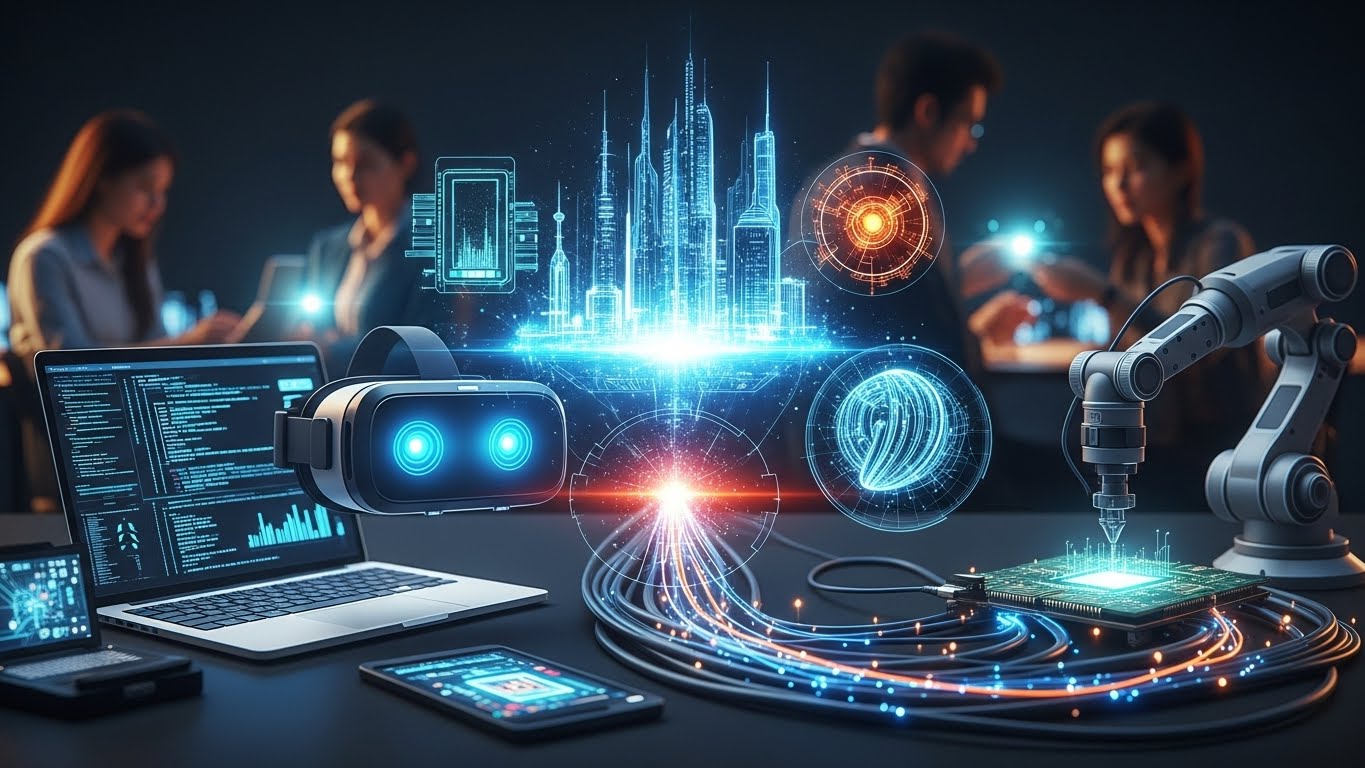
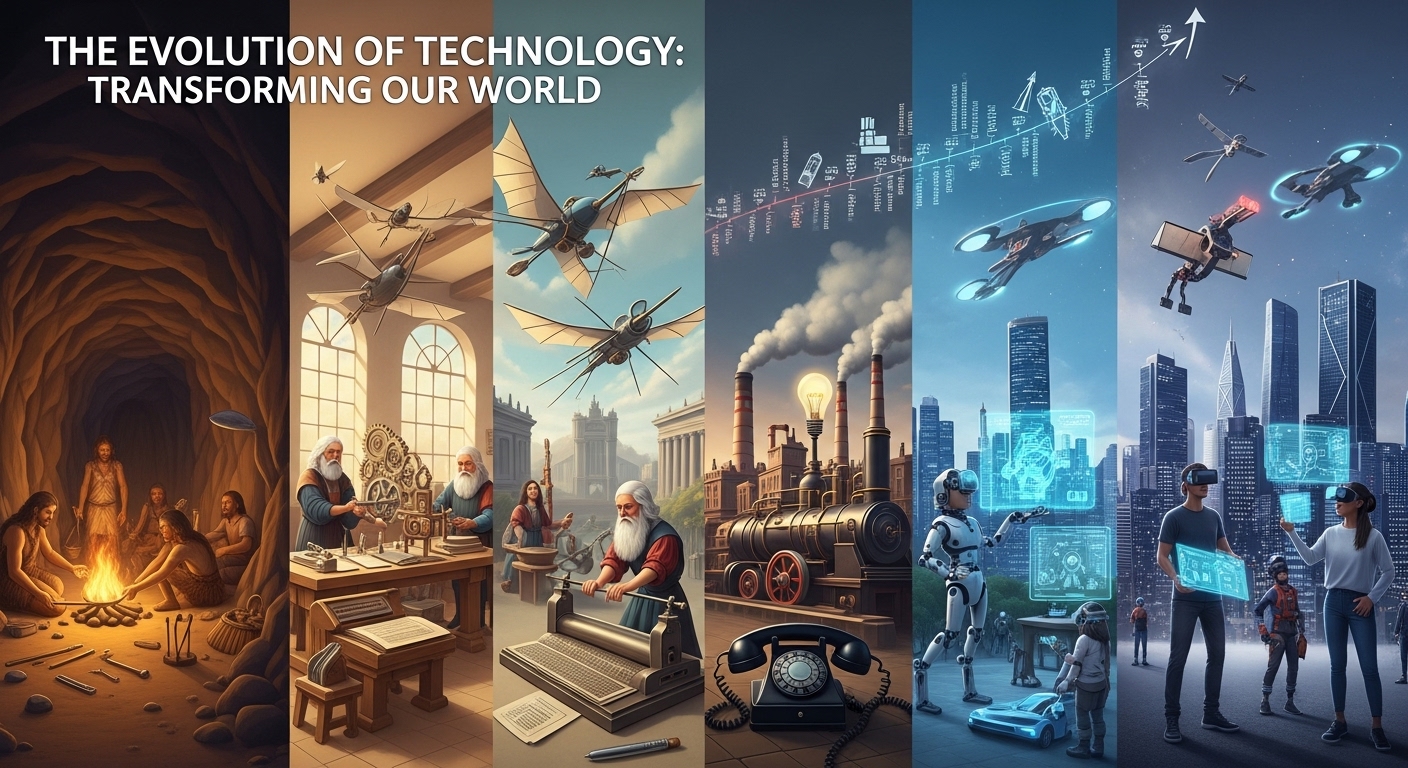
Technology has always been the cornerstone of human progress. From the invention of the wheel to the rise of artificial intelligence, every era of human civilization has been marked by technological breakthroughs that reshaped the way people live, work, and think. The twenty-first century, in particular, has witnessed an unprecedented acceleration in technological development. Today, innovation is no longer a slow, linear process—it’s exponential, global, and deeply intertwined with every aspect of our existence.
This blog explores the journey of technology, how it has evolved over time, and the profound ways it continues to transform our world.
The Dawn of Technology: Humanity’s First Inventions
Technology is as old as humanity itself. The earliest humans used stones to craft tools, hunt animals, and prepare food. These simple tools represented the beginning of innovation—a way for humans to extend their physical and mental capabilities through creativity and adaptation.
The discovery of fire was another monumental milestone. It not only provided warmth and protection but also changed diets and community structures. Later came the invention of the wheel around 3500 BCE, revolutionizing transportation and trade. With the wheel, humans could move goods faster and expand their settlements, laying the foundation for civilizations to grow.
The development of writing systems followed, marking a new chapter in technological progress. With writing, people could record information, preserve knowledge, and pass ideas from generation to generation. This led to the birth of education, governance, and organized societies.
These early innovations, though simple by modern standards, were transformative. They set in motion the endless chain of technological evolution that continues to define human progress.
The Industrial Revolution: The Birth of Modern Technology
The eighteenth century ushered in one of the most transformative periods in history: the Industrial Revolution. With the invention of the steam engine, the world moved from manual labor and agrarian economies to mechanized manufacturing. Factories emerged, railways expanded, and cities grew rapidly.
The Industrial Revolution introduced new forms of energy—coal, steam, and eventually electricity—that powered machines and industries. It gave rise to inventions like the spinning jenny, the telegraph, and the light bulb. For the first time, people experienced mass production, urbanization, and modern communication.
This era also marked the beginning of technological standardization and scientific research. Inventors like James Watt, Thomas Edison, and Alexander Graham Bell changed how people lived and connected. The world became smaller as communication and transportation improved, setting the stage for the next wave of innovation.
The Digital Revolution: The Age of Information
While the Industrial Revolution mechanized physical labor, the Digital Revolution mechanized information. Beginning in the mid-twentieth century, this revolution was driven by the invention of the computer and later the internet.
Computers evolved from massive machines filling entire rooms to compact, powerful devices that fit in our pockets. The first programmable computer in the 1940s paved the way for a new era of computation and data processing. By the 1980s and 1990s, personal computers became household essentials, changing how people worked, learned, and entertained themselves.
The rise of the internet in the 1990s connected the world in ways previously unimaginable. Information that once took days or weeks to access became instantly available. Email replaced traditional letters, websites became digital storefronts, and online education opened opportunities for millions.
This was also the era of software innovation. Operating systems, productivity tools, and early web browsers defined the digital lifestyle. Companies like Microsoft, Apple, and others led the way in making technology accessible and user-friendly.
The Digital Revolution democratized information and created a new economy based on knowledge, connectivity, and innovation. It was no longer about producing physical goods—it was about creating digital experiences.
The Mobile Revolution: Technology in Every Hand
The turn of the millennium brought another massive transformation: the mobile revolution. The invention of the smartphone changed not just technology but the fabric of daily life.
In the early 2000s, mobile phones were primarily communication tools. But with the introduction of smartphones, they became multi-functional devices capable of performing countless tasks—from navigation and shopping to entertainment and education.
The smartphone integrated the internet, camera, GPS, and powerful computing capabilities into a single device. It became the centerpiece of the modern digital lifestyle. Apps transformed industries—from transportation through ride-sharing services to finance through mobile banking.
Social media platforms flourished during this period, redefining human interaction and communication. For the first time, billions of people could share their voices globally, creating a digital society that transcended borders.
The mobile revolution made technology personal, portable, and always accessible. It blurred the boundaries between the physical and digital worlds, giving rise to a new culture of immediacy and connection.
The Era of Artificial Intelligence: Machines That Think
As computing power increased and data became abundant, artificial intelligence (AI) emerged as the defining technology of the 21st century. AI enables machines to analyze, learn, and make decisions—functions once considered uniquely human.
Machine learning, a subset of AI, allows systems to improve their performance without explicit programming. This has led to remarkable advancements in image recognition, natural language processing, and predictive analytics.
AI is now embedded in everyday life. Voice assistants like Siri and Alexa, recommendation algorithms on streaming platforms, and chatbots for customer service all rely on AI. In healthcare, AI assists doctors in diagnosing diseases with higher accuracy. In finance, it detects fraud and optimizes trading. In transportation, it powers autonomous vehicles.
What makes AI revolutionary is its ability to amplify human intelligence rather than replace it. It automates repetitive tasks, enhances decision-making, and unlocks insights from vast amounts of data. However, it also raises ethical and social questions about privacy, bias, and employment.
AI represents not just a technological shift but a philosophical one—challenging humanity to define what intelligence and creativity truly mean.
The Rise of the Internet of Things (IoT): A Connected World
The Internet of Things (IoT) has expanded the digital ecosystem beyond computers and phones to include everyday objects. From smart thermostats and wearable fitness trackers to connected vehicles and industrial sensors, IoT creates a network of devices that communicate and share data in real time.
This interconnectedness enhances efficiency and convenience. Smart homes adjust lighting and temperature automatically. Smart cities optimize traffic flow and energy consumption. In industries, IoT improves logistics, maintenance, and safety.
IoT represents the next phase of digital integration, where technology becomes invisible but omnipresent. It turns data into action, creating systems that adapt to human behavior and environmental conditions.
Cloud Computing: The Power Behind the Digital Age
The rise of cloud computing transformed how technology is used and delivered. Instead of relying on local hardware, users can now access computing power, storage, and software over the internet.
Cloud platforms enable scalability, flexibility, and cost efficiency. Businesses can deploy applications globally within minutes, collaborate in real time, and harness powerful analytics tools without maintaining physical infrastructure.
For individuals, cloud storage ensures that data is always available, regardless of device or location. Services like online backups, photo synchronization, and collaborative editing have become standard features of modern life.
Cloud computing also drives innovation in other fields such as AI, IoT, and big data. It provides the computational backbone for training machine learning models and managing vast information networks.
Cybersecurity: Protecting the Digital Frontier
As technology evolves, so do the threats that accompany it. Cybersecurity has become one of the most critical aspects of the digital era. With billions of devices connected globally, the risk of data breaches, identity theft, and cyberattacks has grown exponentially.
Modern cybersecurity strategies involve encryption, multi-factor authentication, and AI-driven threat detection. Governments and corporations invest heavily in securing systems against hackers and protecting sensitive information.
However, cybersecurity is not just a technical challenge—it’s also a human one. Users must be educated about digital hygiene, phishing scams, and data privacy. As our dependence on technology deepens, safeguarding digital trust becomes essential for maintaining social and economic stability.
Emerging Technologies: The Next Frontier
Beyond AI and IoT, a new generation of technologies is reshaping the future. Each promises to push the boundaries of what’s possible and redefine how humans interact with the world.
Quantum Computing
Quantum computing harnesses the principles of quantum mechanics to perform calculations at speeds unimaginable for traditional computers. Though still in its infancy, it has the potential to revolutionize fields like cryptography, materials science, and artificial intelligence by solving complex problems that would take classical computers centuries to complete.
Blockchain Technology
Blockchain offers a decentralized, transparent, and secure way to record transactions. While it gained fame through cryptocurrencies, its applications extend far beyond finance. It can improve supply chain transparency, secure voting systems, and verify digital identities.
Biotechnology and Genetic Engineering
Advancements in biotechnology are merging digital tools with biological sciences. Gene editing technologies like CRISPR are revolutionizing medicine, agriculture, and environmental science. The integration of bioinformatics and AI enables personalized treatments and faster drug discovery.
Virtual Reality (VR) and Augmented Reality (AR)
VR and AR are redefining how people experience information and entertainment. From immersive gaming to remote collaboration, these technologies create new dimensions of interaction. In education and healthcare, VR enables realistic simulations that improve learning and treatment outcomes.
Renewable Energy and Green Tech
Technology is also driving sustainability. Solar, wind, and other renewable energy technologies are reducing dependence on fossil fuels. Innovations in battery storage, electric vehicles, and smart grids are paving the way for a cleaner, more efficient planet.
The Human Side of Technology
While technology continues to advance, its impact on humanity remains a central question. Innovation brings both opportunities and challenges.
On one hand, technology empowers people by increasing access to information, education, and economic opportunity. It connects families across continents and enables small businesses to reach global markets. It enhances healthcare, improves transportation, and fosters creativity.
On the other hand, it can widen social divides, threaten privacy, and create dependency. Automation and AI raise concerns about job displacement. Social media can amplify misinformation and erode mental well-being. The digital world can sometimes feel overwhelming and intrusive.
Balancing innovation with ethics and empathy is crucial. Technology should serve humanity, not the other way around. The goal should always be to enhance life, preserve human dignity, and promote collective well-being.
The Future of Technology: A Vision Beyond 2025
Looking ahead, technology will continue to evolve faster than ever. The next decade promises deeper integration of digital and physical realities. Smart environments, autonomous systems, and human–machine interfaces will become commonplace.
AI will become more intuitive, capable of understanding emotions and complex contexts. The line between human and machine creativity will blur as AI collaborates with artists, scientists, and educators.
Quantum computing will unlock breakthroughs in medicine, climate modeling, and logistics. Blockchain will redefine trust and transparency across industries. Space technology will push humanity beyond Earth, enabling lunar bases and interplanetary exploration.
However, the future of technology will depend not only on innovation but on responsibility. Ethical AI, sustainable design, and inclusive access will determine whether technology uplifts or divides humanity.
The ultimate question is not what technology can do—but what it should do.
Conclusion: Humanity and Technology in Harmony
From stone tools to supercomputers, technology has always been a reflection of human curiosity and ambition. Each innovation builds upon the last, expanding the boundaries of what we consider possible. Yet, at its core, technology is not about machines—it’s about people.
The story of technology is the story of humanity striving for progress, comfort, and understanding. As we stand at the intersection of biology, intelligence, and digital creation, the choices we make will define the next era of civilization.
To ensure a bright future, we must use technology not just to advance, but to uplift. It must remain a tool for empowerment, connection, and sustainability. The world of tomorrow will be shaped not merely by the brilliance of our inventions but by the wisdom of how we use them.