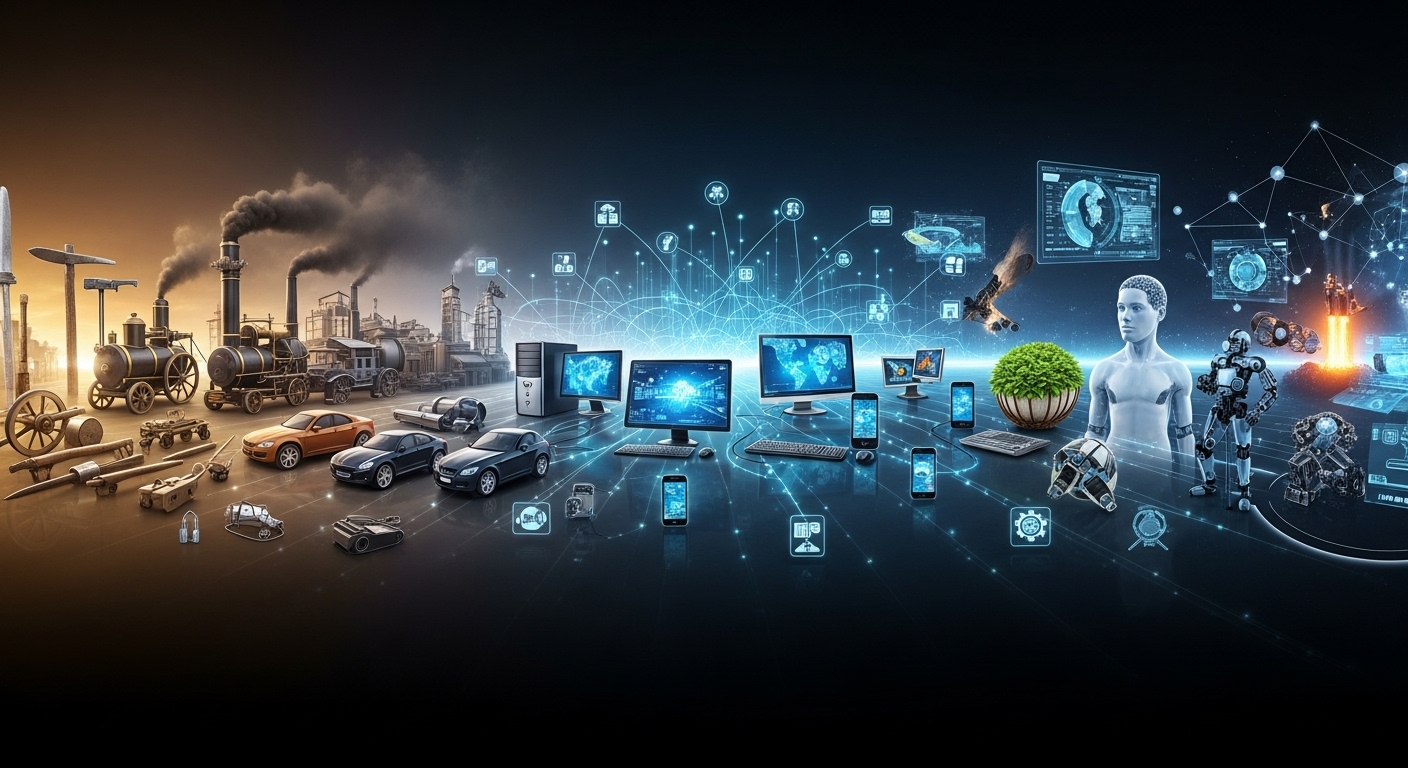
Technology has become the beating heart of modern civilization. It shapes how we live, learn, communicate, work, and even think. The evolution of technology is not just a story of machines and inventions—it’s the story of humanity itself. From the invention of the wheel to the rise of artificial intelligence, every technological leap has redefined human potential and reshaped the boundaries of possibility. In this blog, we’ll explore how technology evolved, what drives innovation, and how it continues to influence every facet of human life.
1. The Dawn of Technology: From Stone Tools to Civilization
Technology did not begin with computers or electricity. It began the moment early humans picked up stones and shaped them into tools. The earliest forms of technology were simple yet revolutionary—stone axes, spears, and fire-making techniques. These innovations were crucial for survival and marked the beginning of human ingenuity.
The discovery of fire allowed early humans to cook food, protect themselves from predators, and migrate to colder regions. The invention of the wheel around 3500 BCE was another monumental leap—it revolutionized transport, agriculture, and trade. Simple machines such as levers, pulleys, and inclined planes followed, setting the foundation for engineering and mechanics.
By the time ancient civilizations like Egypt, Mesopotamia, and the Indus Valley emerged, technology had become intertwined with human progress. Irrigation systems improved agriculture, writing systems recorded history, and metallurgy gave rise to stronger tools and weapons. These early innovations laid the groundwork for the complex societies that followed.
2. The Age of Discovery and Mechanical Invention
As human curiosity expanded, so did the desire to explore and invent. The Middle Ages and the Renaissance were times of great technological advancement. Navigation tools like the compass and astrolabe opened the door to global exploration. Printing technology, invented by Johannes Gutenberg in the 15th century, changed the world forever by democratizing knowledge.
Mechanical innovations such as clocks, watermills, and windmills transformed industries. Architecture flourished through engineering feats like the Gothic cathedral and the Roman aqueduct. Mathematics and science began to blend with technology, giving rise to disciplines like astronomy and mechanics.
The Renaissance spirit of experimentation created a bridge between ancient craftsmanship and modern engineering. Thinkers like Leonardo da Vinci sketched prototypes of flying machines and armored vehicles, demonstrating that imagination could indeed become invention. This period marked the beginning of the human belief that technology could conquer nature itself.
3. The Industrial Revolution: The Birth of Modern Technology
The Industrial Revolution, which began in the late 18th century, was perhaps the most transformative period in human history. Machines took center stage, replacing manual labor with mechanized production. The steam engine, perfected by James Watt, powered factories, ships, and trains—accelerating industrial growth at an unprecedented rate.
For the first time, people moved from farms to cities in search of factory work. Textile production soared, transportation networks expanded, and commerce became global. The invention of the telegraph revolutionized communication, allowing messages to be sent across continents in seconds.
Electricity soon became the new driving force. Thomas Edison’s light bulb illuminated homes and streets, while Nikola Tesla’s alternating current system powered cities. The Industrial Revolution gave rise to engineering as a profession and birthed modern manufacturing. It also introduced the concept of automation—machines performing tasks faster and more accurately than humans.
While the Industrial Revolution brought economic growth and innovation, it also raised new social challenges: pollution, worker exploitation, and the widening gap between rich and poor. Yet, despite its flaws, it established the technological foundations of the modern world.
4. The Digital Revolution: The Rise of Computers and Information
If the Industrial Revolution mechanized the world, the Digital Revolution digitized it. The 20th century witnessed the birth of computing, telecommunications, and electronic devices that changed every aspect of life.
The story began with mechanical calculators and evolved into room-sized computers like ENIAC and UNIVAC. These early machines, though limited, demonstrated the power of computation. The invention of the transistor in 1947 replaced bulky vacuum tubes, leading to smaller, faster, and more reliable computers.
In the 1970s and 1980s, the microprocessor brought computing power to personal devices. Companies like IBM, Apple, and Microsoft ushered in the age of personal computing, putting technology into the hands of ordinary people. Suddenly, homes and offices were equipped with machines capable of word processing, data management, and digital creativity.
The internet emerged as the next great leap. Initially developed for military communication, it soon became a global network connecting people, businesses, and governments. Email, websites, and search engines transformed how information was shared and accessed. The Digital Revolution redefined education, entertainment, and even human interaction.
5. The Era of Connectivity: Mobile Technology and Social Media
The 21st century ushered in an era of unprecedented connectivity. The smartphone became the symbol of modern life—a device that combined communication, computation, and entertainment in the palm of your hand. From the early flip phones to today’s powerful smartphones, mobile technology has become an extension of human identity.
Wireless internet and mobile networks created an always-connected world. Social media platforms emerged as the new public squares, changing how people communicate, share ideas, and build relationships. Platforms like Facebook, Twitter, Instagram, and TikTok redefined the meaning of community and influence.
This era also saw the rise of cloud computing, allowing data to be stored and accessed remotely. Businesses began to operate digitally, schools adopted online learning, and remote work became a global norm. Information became more accessible than ever—but so did misinformation, raising new ethical and social challenges.
6. Artificial Intelligence: The New Frontier of Human Thought
Artificial intelligence (AI) represents the latest—and perhaps most profound—phase in technological evolution. What began as simple rule-based programming has grown into machine learning systems capable of understanding language, recognizing patterns, and making decisions.
AI powers voice assistants, recommendation engines, autonomous vehicles, and even medical diagnostics. Machine learning algorithms analyze vast amounts of data to make predictions and optimize performance. Natural language processing enables computers to understand and generate human language, blurring the line between man and machine.
Artificial intelligence is reshaping industries from finance to healthcare, from manufacturing to art. It is enabling robots to perform complex tasks and helping scientists accelerate research in fields like genetics and climate science. Yet, it also raises deep ethical questions: Will machines replace human jobs? Can AI develop consciousness? How do we ensure that intelligent systems remain fair and transparent?
The challenge of the AI age is not just technological but philosophical. Humanity must learn to balance progress with responsibility, ensuring that technology serves humanity rather than the other way around.
7. Biotechnology and the Merging of Life and Machine
The intersection of biology and technology has opened new frontiers in medicine, genetics, and human enhancement. Biotechnology uses living organisms and molecular processes to develop products that improve life. From vaccines and gene editing to lab-grown organs and personalized medicine, this field is redefining what it means to be human.
The mapping of the human genome unlocked the secrets of our biology. Tools like CRISPR allow scientists to edit genes with precision, offering the potential to cure hereditary diseases. Advances in prosthetics and neural interfaces are enabling people with disabilities to regain mobility and independence.
Wearable technology and health-monitoring devices have made personal health management more proactive. Meanwhile, research into brain-computer interfaces hints at a future where the human mind and machines could work seamlessly together. As technology becomes more integrated with biology, the boundaries between human and artificial are becoming increasingly blurred.
8. The Green Revolution in Technology
As technology advances, so does awareness of its environmental impact. The 21st century has seen a growing focus on sustainable innovation—technologies that minimize harm to the planet while promoting long-term growth.
Renewable energy sources like solar, wind, and hydroelectric power are replacing fossil fuels. Electric vehicles are reducing dependence on gasoline, while smart grids optimize energy use. Environmental sensors and data analytics help monitor climate change and biodiversity.
Green architecture, recycling technologies, and sustainable manufacturing practices are reshaping industries. Technology is being used to combat deforestation, manage water resources, and clean up pollution. The rise of environmental technology shows that innovation can coexist with ecological responsibility.
However, this shift also demands global cooperation and conscious consumer behavior. The future of technology must be guided by sustainability, not just efficiency.
9. The Role of Technology in Education and Learning
Education has undergone a complete transformation through technology. The traditional classroom model has evolved into a hybrid of physical and digital spaces. Interactive whiteboards, digital textbooks, and online learning platforms have made education more engaging and accessible.
E-learning platforms offer courses from universities across the globe, allowing students to learn anytime and anywhere. Artificial intelligence tailors learning experiences to individual needs, while virtual reality enables immersive simulations that make complex concepts easier to understand.
Technology has democratized knowledge. Students in remote areas can now access the same information as those in major cities. Teachers can track student progress with data analytics, and education has become a lifelong process rather than a phase. Yet, the digital divide remains a challenge—access to technology is not equal across all regions.
The future of education lies in balancing technology with human interaction. While digital tools can enhance learning, empathy, mentorship, and creativity remain uniquely human strengths that no machine can replace.
10. Cybersecurity and the Battle for Digital Privacy
As the world becomes more connected, it also becomes more vulnerable. Cybersecurity has become a crucial aspect of modern technology. From personal data to national security, everything in the digital world is a potential target.
Hackers, cybercriminals, and data breaches pose constant threats. Encryption, firewalls, and biometric security are just some of the measures developed to protect digital systems. Governments and corporations invest heavily in cybersecurity to safeguard sensitive information.
Privacy concerns have also grown with the rise of data-driven industries. Every click, search, and online interaction generates data that can be tracked and analyzed. The challenge is to find a balance between convenience and control—between sharing and security.
In the coming years, cybersecurity will not just protect information but define trust in technology itself.
11. The Future of Human Civilization: Technology as a Partner
As technology continues to evolve, its role in shaping humanity’s future becomes ever more significant. The next frontier may involve technologies we can barely imagine today—quantum computing, space colonization, brain-computer integration, and fully autonomous societies.
Quantum computers could solve problems that are currently impossible for classical systems, from drug discovery to climate modeling. Space technology is opening paths to Mars exploration and asteroid mining. Robotics and AI will continue to redefine labor, creativity, and governance.
Yet, the ultimate question remains: will technology make us more human or less? The relationship between humans and machines must evolve from dependency to partnership. Technology should empower creativity, empathy, and progress—not replace them.
The future will belong to societies that can innovate responsibly, integrating ethics with invention.
12. Conclusion: The Eternal Dance Between Humanity and Technology
Technology has always been a mirror reflecting human ambition, curiosity, and creativity. It is neither inherently good nor bad—it is what we make of it. Every invention carries both promise and peril, depending on how humanity chooses to wield it.
From the spark of fire to the rise of artificial intelligence, technology has driven human evolution forward. It has built civilizations, connected continents, and expanded our understanding of the universe. But it has also challenged us to confront our values, ethics, and responsibilities.
As we stand on the threshold of new technological horizons, we must remember that progress without purpose is hollow. The true power of technology lies not in the machines we build but in the wisdom with which we use them. The story of technology is, ultimately, the story of us—and it is far from over.